



 Sam Coleman
What’s different about Wide Bandgap Semiconductors?
The choice of materials used to manufacture semiconductors directly alters their physical and electrical properties.
Today, most semiconductor manufacturing still relies on traditional silicon (Si). However, silicon carbide (SiC) and gallium nitride (GaN), known as wide bandgap semiconductors, have significant advantages over silicon.
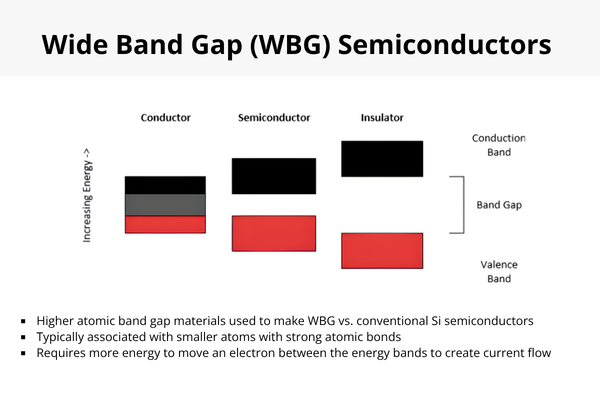
These materials have an electron band gap around three times larger than silicon. Conventional silicon semiconductors used in MOSFETs (metal-oxide-semiconductor field-effect transistors), IGBTs (insulated-gate bipolar transistors), and switching diodes have a bandgap around 1.1 eV. Compare this to wide bandgap semiconductors, SiC and GaN, with band gaps of around 3.2 eV and 3.4 eV, respectively.
Wide Bandgap Semiconductors are Creating a New Generation
of Battery Chargers
With a wider gap between the conduction and valence bands, electrons need more energy to move between the bands, enabling current to flow. This makes WBG semiconductors more robust in extreme conditions. They are less affected by uncontrolled heat, can withstand higher voltages, and have lower leakage currents.
Because of this, battery charger switches using these semiconductors can be smaller and still tolerate higher switching frequency. The result? More efficient battery chargers, with less energy lost as heat and less energy needed for cooling.
And it's these features that are helping to break new ground. These are some of the main advantages:
.png?width=350&height=438&name=article_version%20(1).png)
High Reliability, Low Failure
Used in defense and aerospace systems for decades, high-frequency power converters have been tried and tested in extreme and demanding environments. However, in the past, they’ve been more complex to engineer than conventional converters. This has been a major barrier to their adoption in the critical power industry, where reliability is the primary concern. Understandably, the sector has been cautious about a technology that may present more risk.
Enter WBG semiconductors.
These can operate reliably at higher junction temperatures than silicon equivalents - though in practice, packaging limits keep most devices to around 175–200 °C. They have an increased breakdown voltage and breakdown field, with lower leakage currents. Applied together, these properties allow higher deratings (operating below maximum capacity to extend lifespan) in SiC or GaN designs under the same stress conditions as silicon, which can support comparable or improved reliability in properly engineered designs.
The critical power sector can have its cake and eat it too.
Tried and Tested
WBGs are used extensively in electric vehicle charging. Before their widespread adoption, the JEDEC (Joint Electron Device Engineering Council) carried out highly accelerated life testing on SiC and GaN parts. Many of these are also qualified to AEC (Automotive Electronics Council) standards.
Here at SENS, in our own like-for-like internal platform comparison, the field failure rate of the high-frequency charger is almost identical to the simpler SCR charger and the rate of hardware failure was actually lower.
%20Semiconductors.png?width=618&height=412&name=Wide%20Band%20Gap%20(WBG)%20Semiconductors.png)
The bottom line? You don’t have to sacrifice reliability to achieve the performance benefits that WBG semiconductors bring to battery chargers.
More Power
Wide bandgap semiconductors deliver more efficient battery charger designs. They can operate at higher voltages with faster dynamic response and lower output ripple.
Key to this is their higher breakdown voltage, which allows electrical devices using WBG semiconductors to operate at higher voltages with lower leakage currents than those designed with traditional silicon semiconductors.
These properties also allow thinner device layers and smaller die sizes which reduce losses during switching and requires lower drive power.
The result? More power…
… and in Less Space
WBG devices can switch faster than those with silicon in the same conditions. In buck converter designs (which step down voltage efficiently), WBGs enable a smaller inductor size and an overall reduction in buck converter volume. In SENS's own optimized converter analysis, the silicon design was 3.5x larger than the SiC version and 5x larger than the GaN version - numbers that rise to 4.2x and 8x respectively when capacitor types are also optimized.
Lower power losses also means less cooling is needed. Heatsinks can be smaller, resulting in a reduced physical enclosure size. With their smaller, lighter design, WBG chargers have a smaller footprint and are less expensive to ship.
Delivering Efficiency Gains
Looking at the advantages gained from the wider gap between the conduction and valence bands, electrical devices designed with WBG semiconductors lose less energy through heat. They need less cooling when compared with silicon due to:
- A higher breakdown voltage
- Lower leakage currents
- Lower power losses in switching
%20Semiconductors%20(1).png?width=600&height=400&name=Wide%20Band%20Gap%20(WBG)%20Semiconductors%20(1).png)
With reduced cooling and higher efficiency, WBG battery charging designs offer lower operating costs.
But are WBG Semiconductors More Expensive?
WBG materials themselves do tend to cost more than silicon, and WBG semiconductors are more expensive at the component level; today, SiC parts can run around 2.2x the price of a comparable silicon part, and GaN parts around 2.8x. However, manufacturing is catching up. Processes are becoming more developed, and as production volumes grow, costs are coming down.
While WBG semiconductors may be more expensive, the costs are offset by the smaller capacitors, heatsinks, and enclosures needed in WBG battery charger designs. And their increased efficiency reduces overall operating costs.
Wide bandgap semiconductors are revolutionizing battery charging design. They enable more efficient devices than silicon equivalents, deliver more power in less space, are easier to install and service, and are more efficient to run. Crucially, in properly engineered designs, they have demonstrated comparable or improved real-world reliability, even in harsh environments. The result is a step-change in efficiency and productivity without sacrificing the gold-standard reliability the critical power industry relies on.
For an in-depth look at wide bandgap semiconductors, read our technical white paper.