 Sam Coleman
Why did utility engineers resist switchmode technology for so long?
The hesitance to adopt switchmode was never about a lack of performance; it was about the ability to survive. While switchmode power conversion has dominated nearly every other segment of the economy (including demanding aerospace and military systems), the transition in the utility sector was slow.
Industrial and power utility facilities often drive large battery chargers with 480-volt, 3-phase electrical service. Most high-volume switchmode chargers, however, were originally derived from telecom-type rectifiers designed for protected environments and single-phase 240-volt AC supplies. When these units were forced into a utility substation, they struggled with the lack of a neutral conductor and the higher line-to-chassis voltage stresses found in common 3-phase grounding schemes like corner grounding.
Beyond electrical compatibility, the reliance on forced cooling was a major psychological hurdle. Fans were perceived as a weak point because they pull in dust and grime, which eventually cakes onto electronic components. If a fan fails or the internal logic shuts down due to thermal stress, the outcome is unacceptable in a mission-critical application.
What does the real-world field data reveal about SCR vs. switchmode reliability?
The most common argument against switchmode technology is that it lacks the long-term, bulletproof reliability of legacy hardware. At Stored Energy Systems (SENS), we manufacture both technologies in high volume, so we have a unique dataset to test this assumption.
When we compared field failure rates specifically caused by lightning transients in identical engine-starting applications, the results were almost identical.
- SCR charger failure rate due to lightning: 1.66 per 10,000 units.
- Switchmode charger failure rate due to lightning: 1.64 per 10,000 units.
This data proves that reliability is not a property of the converter topology itself, but of the engineering behind the unit. When a switchmode platform is designed with a utility mindset, it can match or even exceed the performance of the most rugged legacy designs while providing all the benefits of high-frequency conversion.
Why was switchmode historically more vulnerable to grid transients?
To understand the skepticism, you have to look at the physics of the powertrain. In a legacy SCR charger, the massive 60 Hz isolation transformer is located upstream of the semiconductor switches. This transformer acts as a natural low-pass filter, which means it allows 60 Hz power to transfer while blocking the high-frequency voltage transients typical of lightning strikes.
Traditional switchmode designs do not have this luxury. To save weight and size, they move the power semiconductors ahead of the transformer. Without that 127-lb block of iron to hide behind, the sensitive silicon is directly exposed to every transient and overvoltage event on the AC line.
How can power electronics be hardened against electrical overstress?
Hardening a switchmode charger for a substation requires replacing the filter effect of the old transformer with multiple stages of active and passive protection.
The primary protection layer consists of field-replaceable UL 1449 surge suppressors connected directly to the input and output terminals. These cartridges clamp transient energies at the device terminals, which reduces the stress on non-replaceable protection devices deeper in the system.
Deeper inside each rectifier module, we incorporate metal oxide varistor (MOV) clamps and gas discharge tubes into the electromagnetic interference (EMI) filter. MOVs between the lines provide differential mode clamping, while an MOV in series with a gas discharge tube at the synthetic neutral provides common mode (line-to-chassis) protection. This configuration ensures that even in a corner-grounded system, the discharge arc is extinguished at the end of the transient.
We use additional surge clamping diodes that allow excess voltage to bypass the boost converter circuit and land safely in a bulk reservoir capacitor. This capacitor can absorb large amounts of energy, effectively limiting the voltage rise across the phases.
Why is air contamination the "Achilles heel" of forced-air cooling?
A common objection to switchmode technology is the cooling fan. Part-count reliability models show that fan failure rates typically exceed those of electronic components because the fan is the only continuously moving part in the system.
However, the real problem is not the fan motor itself, but the airborne dirt that fans force into the cabinet. In heavy industrial and outdoor environments, the atmosphere can contain corrosives, conductive dust, and salt fog. These contaminants accumulate on circuit boards, creating short circuits between traces or forming an insulating blanket that bakes components by preventing heat transfer.
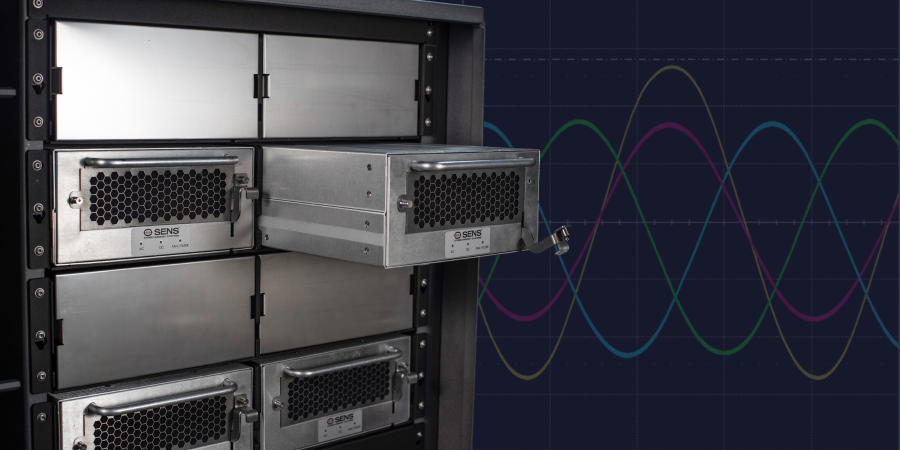
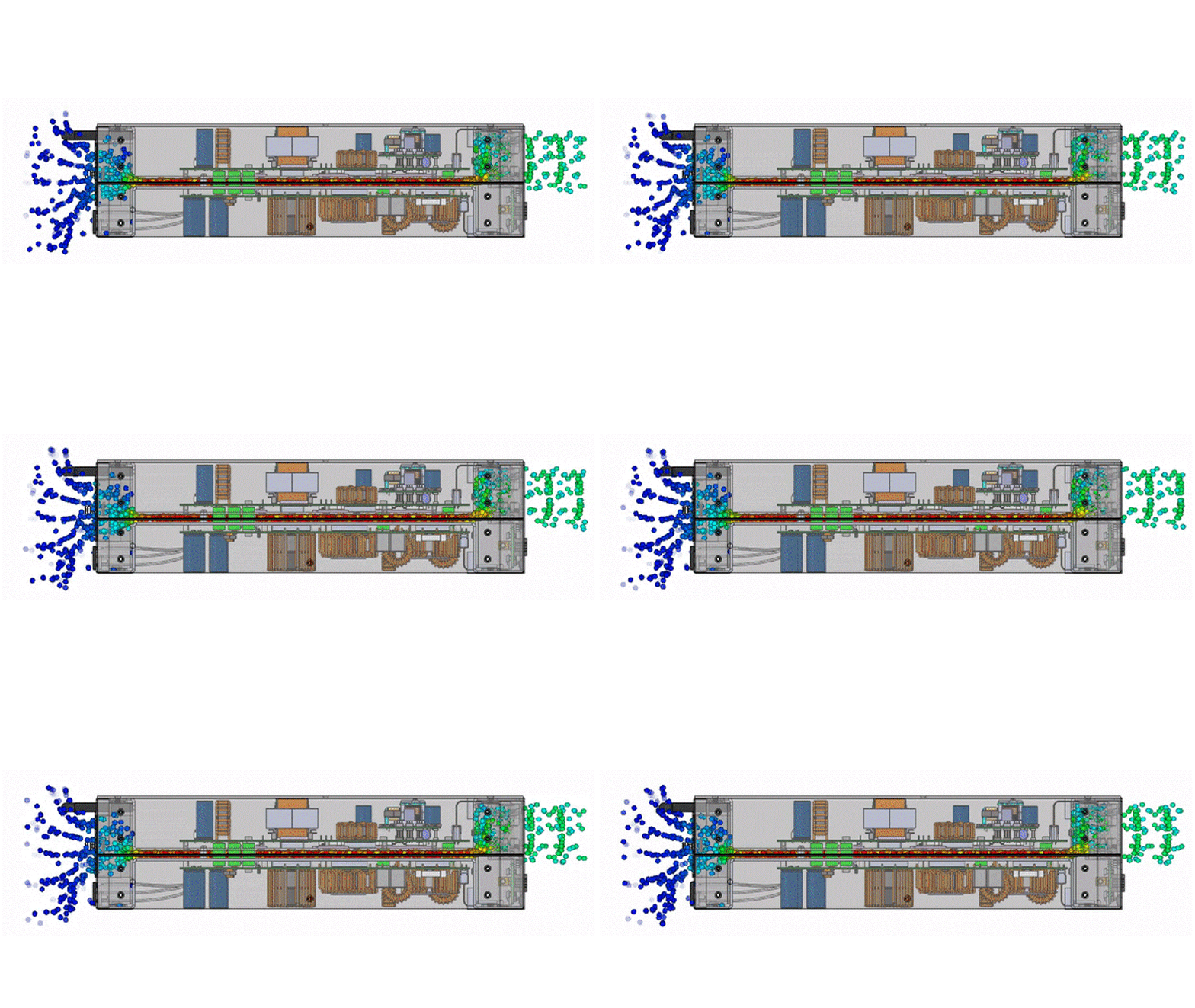
We solved this through a design we call forced conduction cooling. We seal the core power electronics inside two metal Faraday cages. A central aluminum heat exchanger is located between these sealed boxes. Heat is transferred via conduction from the circuit cards into the exchanger, and the fans then drive air through the exchanger to dissipate the heat into the environment. This ensures that sensitive electronics are fully sealed and protected - airflow never actually touches them.
How do efficiency regulations and material costs impact the procurement decision?
While reliability was once the only metric that mattered, procurement has changed significantly in the last few years. This is because SCR chargers are material-intensive products, as they rely on large volumes of copper and iron. Since 2019 the factory cost of SCR chargers spiked as global supply chains for raw materials became volatile.
Switch mode systems use roughly 10% of the weight in magnetics, which made their pricing far more stable during the same period. Beyond the initial purchase price, the efficiency gains are substantial. A 95% efficient switchmode design consumes significantly less power than an SCR unit of the same output. For a 56-kW charger loaded to one-third capacity, this improved efficiency represents nearly $1,000 in saved electricity costs every year.
Government regulations are also changing the legal realm. Energy efficiency laws in states like California and Oregon have already made SCR chargers illegal for sale since 2017. Using a three-phase boost converter topology anticipates these regulations being extended to more jurisdictions.
Why is the reliability conversation shifting from hardware to software?
All modern battery chargers are software-controlled, regardless of their internal power conversion topology. This is why, especially since our grids are getting smarter by the day, the risks to system uptime transit from the hardware to the firmware.
Firmware control offers incredible flexibility, allowing a single hardware platform to be configured for a wide variety of roles, but it also introduces a new level of complexity. As embedded software complexity grows, the organizational resources required for validation and testing grows exponentially.
A battery charger in a mission-critical facility is the last line of defense. It has to be as resilient as the facility it protects. By acknowledging the historical failures of early switchmode systems and engineering specifically for the harsh reality of the substation, we’ve moved past the era of tradeoffs. You can now have the efficiency and modularity of a modern converter with the ruggedness of a transformer-based design.
Want to take a technical deep dive? Read the full white paper.