
 Eric Solanyk
AI-driven computing is accelerating data center construction while pushing datacenter projects to unprecedented scale. Large datacenters today span from 50 to 200 megawatts, while datacenter campuses in design and development exceed multiple gigawatts.
At the same time, developers are being asked to deliver these projects on compressed schedules despite constrained engineering, labor, and supply-chain resources. The traditional model - specifying equipment from multiple suppliers and integrating it in the field - becomes harder to manage as projects grow. Every added interface creates another point that must be engineered, coordinated, installed, tested, and commissioned.
For data center builders, project execution traditional ways no longer meets construction requirements of tomorrow’s datacenters. Datacenter deployment must be predictable, repeatable and scalable. That is why factory-built, modular infrastructure is gaining importance across the data center ecosystem: more engineering, assembly, integration, and testing can be completed before equipment reaches the site.
The same shift is increasingly relevant to the electrical infrastructure that powers datacenters. Moving from individually specified components toward pre-engineered, integrated systems reduces deployment risk, improves consistency, and creates an electrical architecture that is easier to replicate and adapt as requirements change.
The Traditional Delivery Model is Under Pressure
Data center electrical infrastructure has traditionally been delivered through a component-based model. Equipment is sourced from multiple suppliers, shipped to the project, and assembled into a functioning system by engineers, electricians, contractors, and commissioning teams.
That approach can work well at smaller scale, but it becomes more difficult to replicate across large, multi-building campuses. More components means more suppliers, more interfaces, and more opportunities for schedule disruption. A delay in one critical item holds up downstream work, while field integration issues surface late in the project when changes are more expensive and time-consuming.
As developers build larger facilities in more locations, repeatability becomes increasingly valuable. The goal is not simply to procure the right equipment; it is to create an electrical system that can be deployed with consistent performance, schedule, and quality from one project to the next.
From Components to Deployable Systems
One way to improve repeatability is to move more work upstream. Instead of delivering individual components that must be integrated onsite, larger portions of the electrical system can be engineered, assembled, integrated, and tested in a controlled factory environment before shipment.
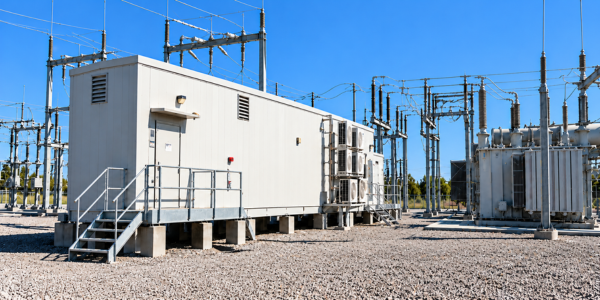
Electrical buildings, power distribution systems, cooling infrastructure, and other supporting systems are already moving in this direction. When these systems arrive as ready-to-deploy building blocks, the project requires less field assembly and fewer integration steps. Commissioning becomes more predictable because more of the system has already been validated before it reaches the job site.
This model can also improve scalability. By defining and validating designs earlier, developers can reserve manufacturing capacity, standardize interfaces, and deploy proven configurations across multiple campuses rather than rebuilding the same solution project by project.
Electrical Requirements Are Changing at the Same Time
The push toward repeatable deployment is occurring while data center electrical requirements are also evolving. Larger facilities and higher-density computing environments are increasing the importance of medium-voltage distribution and changing how power moves through the facility.
Those changes affect more than the primary distribution equipment. Switchgear, controls, communications, DC power, protection, and supporting infrastructure must operate together as a coordinated system. As the electrical architecture becomes more complex, optimizing individual components in isolation becomes less useful.
A system-level approach provides a more stable foundation. Core building blocks can remain consistent even as individual technologies, voltage levels, or equipment configurations evolve over time.
Designing for a Moving Target
Data center infrastructure is designed years before a facility is energized. During that time, AI chip generations, rack densities, and associated electrical requirements continues to evolve. A design based on today's computing environment needs to support very different equipment by the time the facility is operating.
Modular electrical architectures make that uncertainty easier to manage. Rather than redesigning an entire facility when requirements shift, developers can adapt individual power blocks or system modules. This allows the electrical infrastructure to evolve with the computing technology it supports while preserving the underlying deployment model.
Extending Modularity to DC Backup Power
The same modular philosophy can be applied to the DC backup power required by critical electrical equipment. Medium-voltage switchgear, for example, depends on DC power to keep controls and communications available during grid transitions and outages.
Traditionally, that function is supported by a dedicated battery room containing batteries, chargers, distribution panels, ventilation, wiring, and related infrastructure. The room consumes valuable floor area and introduces another collection of components that must be procured, installed, interconnected, and commissioned in the field.
A more integrated approach packages DC backup power as part of the pre-engineered electrical system and locates it closer to the equipment it supports. As illustrated below, this eliminates the need for a separate battery room and reduces both the building footprint and the amount of supporting infrastructure. It also simplifies procurement, field assembly, and deployment by turning another collection of discrete components into a defined system.
.png?width=1400&height=1400&name=image%20(1).png)
Figure 1. Comparison of an E-House with a traditional dedicated battery room (top) and an integrated DC backup power system (bottom), illustrating the potential reduction in both building and system footprint.
Designing Electrical Infrastructure for Scalability and Flexibility
As data centers continue to grow in size and complexity, electrical infrastructure must scale without becoming increasingly difficult to deploy. That requires a shift from treating each project as a new collection of components toward treating the electrical architecture as a complete system that can be engineered, validated, manufactured, and replicated.
Integrating primary power distribution with supporting functions such as backup power reduces the number of field interfaces and creates more complete building blocks for deployment. In this model, electrical infrastructure begins to look less like a one-off construction project and more like a repeatable product - one that can be deployed across multiple campuses and adapted as requirements change.
For data center leaders, the opportunity is to design speed, scalability, and flexibility into the electrical architecture from the beginning. The more that engineering and integration can be completed before equipment reaches the site, the easier it becomes to build large facilities predictably while preserving the flexibility to respond to what comes next.
This article was first published in TMCnet.